LoopedLease
Project overview: Creating a minimal viable product for a peer-to-peer marketplace focused on college subletting.
Role
I was the sole designer and worked on customer discovery and research. I also recruited two software engineers to develop the platform.
Tool
Figma
Duration
6 Months
The Problem:
Every year millions of college students and their families are forced into signing 12 month legally binding leases. Despite the fact that the academic calendar year usually lasts around 9 months, leaving most college housing units vacant at least 3 months out of the year.
That's excluding Internships, co-ops, study abroad programs, mid-year graduations, medical issues or any of the other reasons that may lead a student to step away from their college housing obligations.
Research & Analysis:
User interviews :
We set out to figure out if students had ever been a part of either side of the subletting process (Guest or Host). What solutions students were currently using to search for or list their sublets, and if successful in finding someone, how did they handle payments month to month.
The goal was to find out overall what problems did users have with the current college subletting landscape or if it was a problem at all.
How are students currently handling payments?
Venmo
Zelle
Check/Cash
What services do students currently use?
Facebook.
Craigslist.
Word of mouth.
Property management companies.
More than one platform.
Problems with current subletting solutions?
Problems with post getting lost in group feeds, having to repost.
Facebook groups not optimized only for subletting.
messages from people your not friends with get sent to separate hard to find inbox.
Some listings have different information (no pictures, no price, no location etc.)
having to post to multiple platforms.
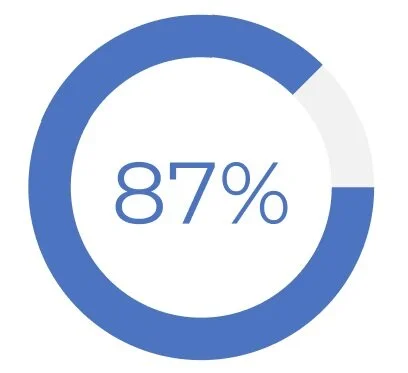
Out of 217 interviews 87% of respondents reported using more than one one platform during the subletting process.
User pain points:
From our user interviews, we found that these three problems seemed to be most common among users.
Consolidation: No one central solution for subletting. Users are spread between Facebook groups, craigslist, group chats and others.
Standardized information: Some listings have pictures, others don’t, some list the price, others just list the semester.
Verification: Anyone can join a Facebook group or post on craigslist, we found that word of mouth had the highest rate of trust.
Competitive Analysis:
We conducted a competitive analysis to get a visual representation of the current markets offering, while also exploring how we could potentially fill the gaps.
User Personas:
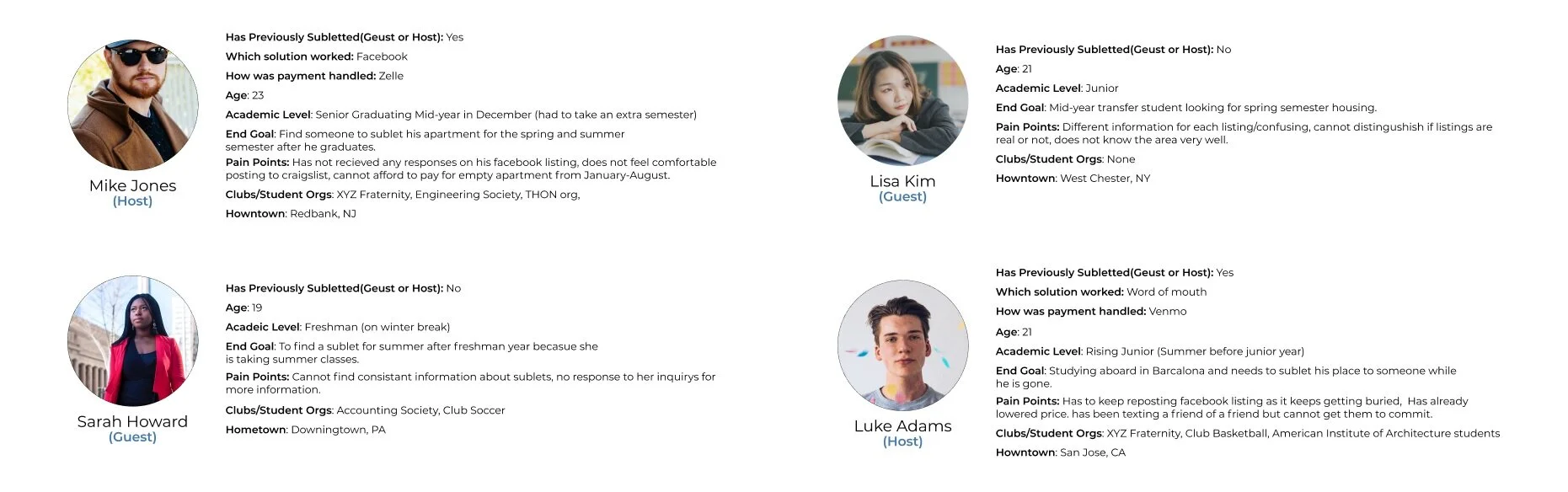
I created user personas based on the user interviews. The personas also ensured that user goals and pain points were at the front of my mind as I progressed with the design.
Early Low-Fi sketch of Booking(Top) and Listing(Bottom) flows.
User Flows:
With the data gathered from user interviews we decided on the most essential flows to build for the minimal viable product, which by definition contains only the features necessary to solve the problem.
Booking a place.
Listing a place
Creating a profile
Payment Method
Payout Method
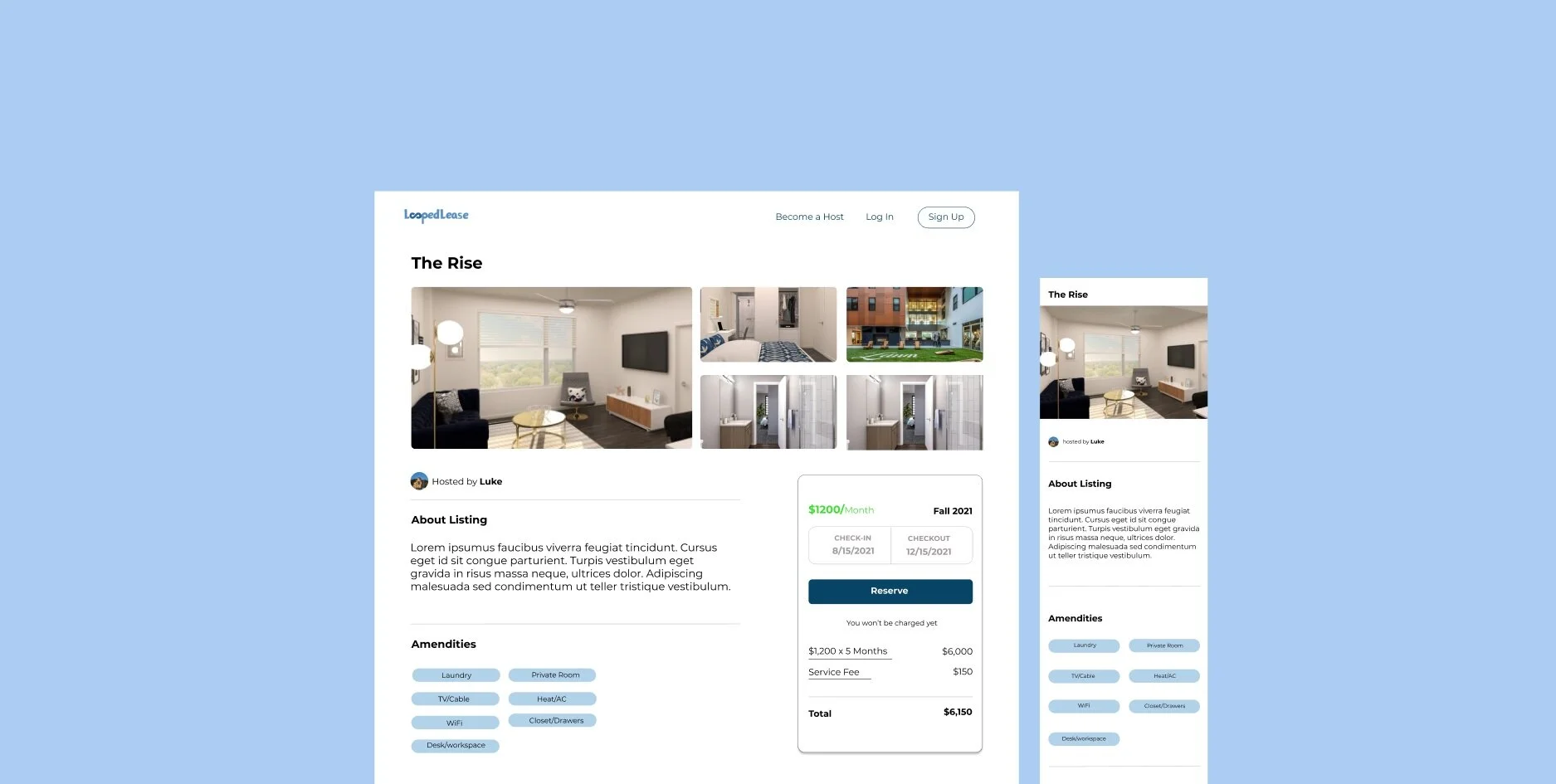
View of a listing mockups (Web & Mobile):
Confirm and pay mockups (Web & Mobile):
Prototyping:
It was time to put all the different flows together to get a fully functioning prototype together to see if it made sense to real users.
All the flows
User testing:
We gathered 5 users from our user interviews to conduct testing on. We gave them certain tasks like; “Find a place and book it”. From those tasks we would observe how they navigated the site or if they had any trouble at any point.
Feedback:
the main pain came from trying to search for a place. Originally we had made the assumption that it would be simpler to search by just the desired semester and the price instead of a targeted date search.
But it turned out that the search by semester just created another step for both guests and hosts, as they had to determine desired dates in direct messages instead on having it automatically filled in from a targeted date search.
Changed search feature after user testing
Conclusion: Results & Takeaways.
This product was launched mid-February 2020 to a market of 40K, unfortunately, a few weeks later the Covid-19 pandemic hit the U.S. So the product was shelved and is now more of a side project than a startup.
Although the project is no longer live, the process of taking something from idea to reality was rewarding in itself.
Biggest Takeaways:
Know your user & competition: User research is key to building an application that actually solves the problem it intends to, and that people will actually want to use.
When it comes to competition, sometimes less is more. The aim should not be to have more features, or cover more verticals of business then your competition. The aim should be to first help users solve one problem in the simplest way possible, adding features is always easier than taking them away.
Building a team: It is about more than a great idea, you must have a vision forward that people can believe in, and to have tested that idea before you start asking people to build it for you.
More so, it is about understanding the motivations of each individual and figuring out a way to fuel them in times of uncertainty.
<< View last project
View next project >>